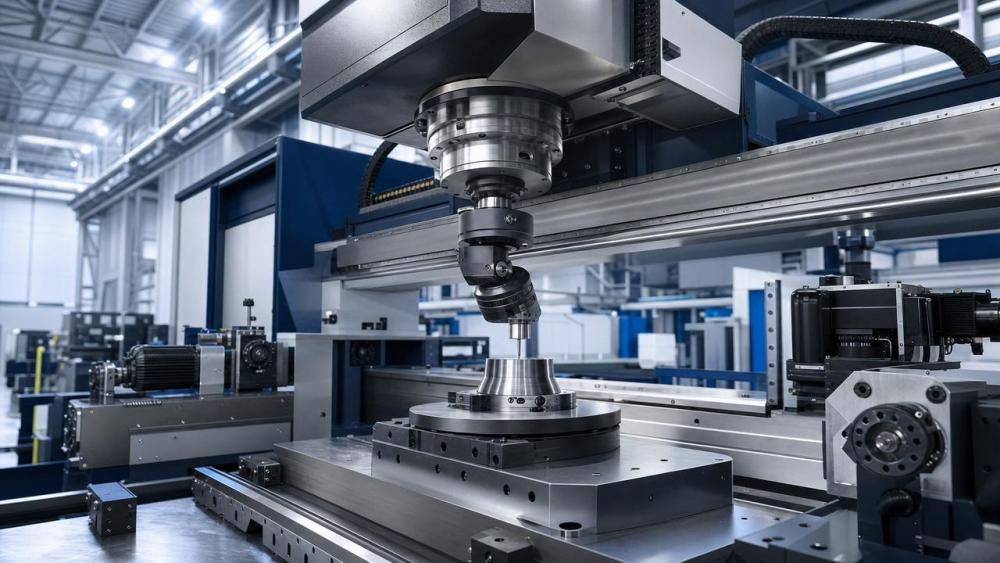
On May 27, 2026, the U.S. Department of Commerce’s Bureau of Industry and Security (BIS) added gantry-type 5-axis machining centers equipped with real-time Rotational Tool Center Point (RTCP) compensation and positioning accuracy better than ±1.5 μm to Supplement No. 7 to the Export Administration Regulations (EAR). This regulatory change directly affects manufacturers, exporters, and users in precision metalworking, aerospace, defense, and high-end energy equipment sectors — particularly those engaged with China, Russia, Iran, and 39 other jurisdictions listed in the rule.
Event Overview
On May 27, 2026, BIS published a temporary final rule (89 FR 42871) amending the EAR to include specific gantry-configured 5-axis machine tools featuring RTCP algorithms and sub-1.5 μm positioning accuracy in Supplement No. 7 — the ‘Advanced Manufacturing Items’ list. Exports of these systems to 42 designated countries now require a license; average review time is expected to exceed 90 working days.
Industries Affected by This Change
Direct Trade Enterprises
Companies exporting or re-exporting gantry 5-axis machining centers from the U.S. — including OEMs, integrators, and distributors — must now obtain individual export licenses for shipments to the 42 listed destinations. The requirement applies regardless of end-user type or stated application, as long as technical specifications meet the control criteria.
Manufacturing & End-User Companies
Firms in aerospace, turbine manufacturing, nuclear component production, and medical device fabrication that rely on imported gantry 5-axis machines with RTCP capability face potential delays in equipment procurement and upgrades. Integration timelines for new production lines or capacity expansions may be extended due to licensing uncertainty and longer lead times.
Supply Chain & Integration Service Providers
System integrators, automation solution providers, and after-sales service organizations supporting U.S.-origin gantry platforms may encounter restrictions on software updates, firmware patches, or remote diagnostics involving RTCP-related functionality — especially when delivered to controlled destinations.
Key Points for Enterprises and Practitioners
Monitor official guidance and potential revisions to licensing policies
The rule is issued as a temporary final rule, meaning BIS may adjust implementation details following public comment. Stakeholders should track updates in the Federal Register and BIS advisory notices, particularly regarding possible exemptions for civil aviation or nuclear safety applications.
Verify technical specifications against EAR control parameters
Not all gantry 5-axis machines are subject to control — only those meeting both the RTCP algorithm requirement and the ±1.5 μm positioning accuracy threshold. Enterprises should conduct internal technical reviews or engage qualified third-party verification before initiating export or import processes.
Distinguish between policy signal and operational impact
While the rule takes effect immediately upon publication, enforcement focus and interagency coordination (e.g., with State Department’s DDTC on dual-use overlaps) remain evolving. Current enforcement appears prioritized toward high-value, high-precision units rather than legacy or retrofitted systems lacking documented RTCP implementation.
Prepare documentation and contingency plans for procurement and support workflows
Organizations planning near-term acquisitions should initiate license applications early and maintain full technical documentation (including calibration reports and algorithm architecture summaries). Where feasible, evaluate alternative non-U.S.-origin platforms or modular configurations that decouple RTCP functionality from controlled hardware components.
Editorial Perspective / Industry Observation
Observably, this amendment signals a deliberate shift in U.S. export control strategy: from targeting discrete AI chips or training infrastructure to controlling AI-embedded physical systems where algorithmic performance directly enables precision manufacturing outcomes. Analysis shows that RTCP is not merely a software feature but a system-level capability tightly coupled with motion control, sensor fusion, and real-time computing — making it functionally analogous to an AI-enabled industrial actuator.
This action is better understood as a regulatory signal than an immediate operational barrier. While licensing requirements are now codified, actual enforcement thresholds, interpretation of ‘RTCP implementation’, and inter-agency alignment are still developing. The industry should treat this as a structural inflection point — not just a compliance checkpoint — requiring sustained attention to both technical definitions and policy trajectory.
Conclusion
This regulatory update reflects a broader trend of export controls expanding into AI-integrated industrial platforms — where algorithmic capability becomes a controlled attribute of physical equipment. For affected enterprises, the most rational interpretation is not alarm but recalibration: aligning technical documentation, procurement timelines, and supply chain design with a more granular, performance-based control framework. Continued monitoring — rather than reactive adjustment — remains the most effective posture at this stage.
Source Attribution
Primary source: U.S. Department of Commerce, Bureau of Industry and Security (BIS), Temporary Final Rule, 89 FR 42871, published May 27, 2026.
Areas under ongoing observation: BIS public comment period responses, potential interagency guidance on RTCP definition, and enforcement patterns in initial license reviews.
Product Recommendations
 Abrasive Delivery SystemsIndustrial Waterjet Cutters: Abrasive Costs That Erode MarginsAnalyst :5-Axis Machining Scientist
 All-Electric Press BrakesAll-Electric Servo Drives: Energy Savings vs Upgrade CostAnalyst :Precision Turning Architect
 All-Electric Press BrakesReal-Time Angle Compensation: What It Fixes and What It Doesn'tAnalyst :Precision Turning Architect
 Latest Sector NewsHigh-Strength Steel Machining: Tool Life Myths to AvoidAnalyst :Dr. Alistair Vaughn
 3D 5-Axis LaserComposite Material Cutting Without Delamination: Key MethodsAnalyst :
 Robotic Bending CellsAutomated Sheet Metal Forming: Hidden Setup Costs ComparedAnalyst :Precision Turning Architect