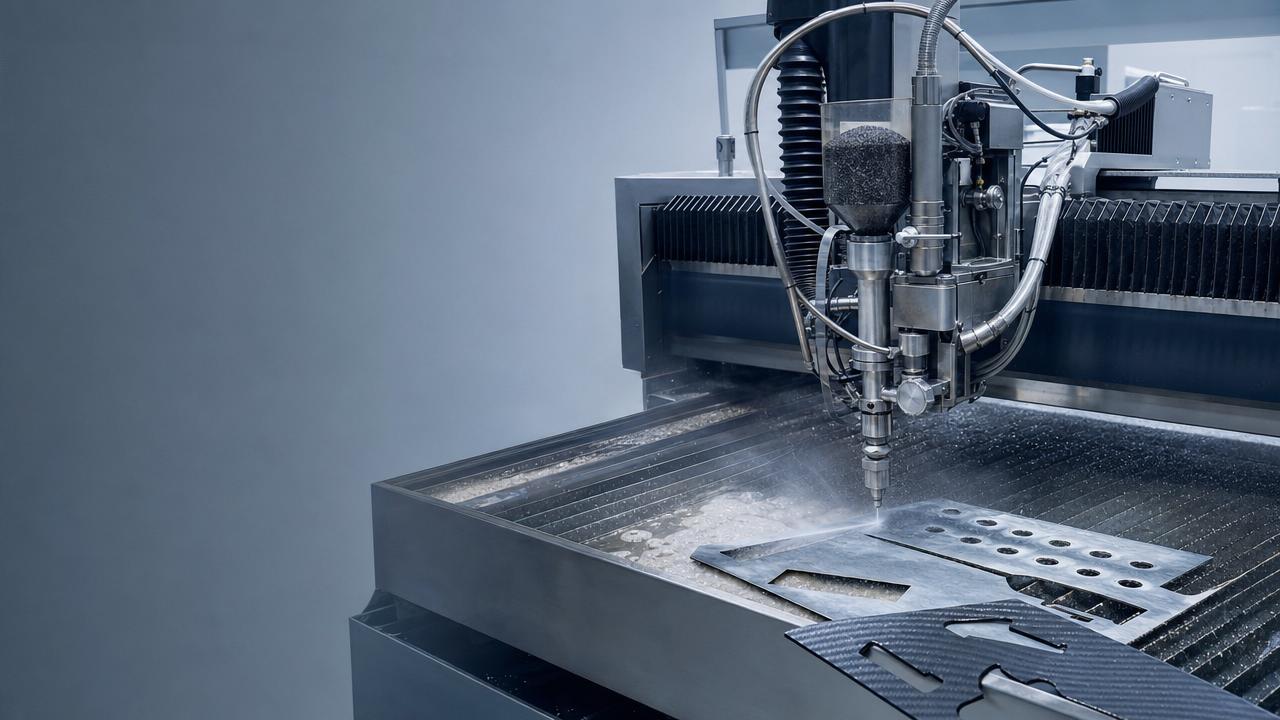
For business evaluators, industrial waterjet cutters often appear to be a reliable answer for heat-free precision across metals, composites, glass, stone, and advanced materials. The value proposition is easy to understand: no heat-affected zone, broad material compatibility, and clean edges on difficult parts. Yet the financial picture is less obvious. In many operations, abrasive use becomes the hidden variable that steadily narrows margins, especially when garnet prices rise, cutting parameters are poorly optimized, or waste handling is treated as an afterthought. Understanding the true economics of industrial waterjet cutters requires looking beyond machine price and nominal cut speed to the full operating cost structure over time.
A clear shift is underway: operating economics now matter more than cutting versatility alone
The market position of industrial waterjet cutters is changing. In the past, the technology was often justified primarily by its unique cold-cutting capability. That remains important for aerospace carbon fiber, titanium alloys, laminated materials, bulletproof glass, and heat-sensitive assemblies. However, current evaluation standards are becoming more demanding. Decision criteria increasingly include abrasive cost per part, nozzle wear rate, mixing tube life, downtime, pump maintenance intervals, wastewater handling, and nesting efficiency.
This shift is especially visible across advanced manufacturing environments where precision equipment must prove both technical and financial resilience. In facilities balancing laser cutting, 5-axis CNC machining, press brake forming, and waterjet processing, industrial waterjet cutters are no longer assessed as isolated specialty machines. They are measured against throughput targets, energy strategy, material utilization, and the total contribution they make to a mixed-process production line. That broader lens exposes abrasive consumption as one of the most important variables in long-term ownership economics.
Why abrasive costs are rising from a line item to a strategic issue
Several forces are pushing abrasive economics to the center of investment analysis for industrial waterjet cutters. The issue is not only the purchase price of garnet, but also how consumption interacts with quality, uptime, labor, and waste.
In short, the economics of industrial waterjet cutters are being shaped by the same forces affecting the broader advanced manufacturing sector: tighter tolerances, shorter production windows, and stronger demand for measurable cost discipline.
The hidden erosion often starts in places that standard quotes do not show
Quoted machine cost and basic cutting demonstrations rarely reveal where profitability leaks develop. In practice, abrasive-related erosion tends to emerge through a combination of visible and hidden mechanisms.
- Overconsumption by conservative programming: Operators often raise abrasive flow to protect edge quality, even when pressure, traverse speed, or nozzle condition is the real issue.
- Poor match between abrasive grade and application: A one-size-fits-all approach can waste media on soft materials or underperform on thick, hard, or laminated parts.
- Wear-driven inefficiency: Orifice and mixing tube degradation can reduce jet coherence, forcing slower cuts and more abrasive to maintain specifications.
- Waste in tank management: Spent garnet removal, sludge buildup, and cleanup labor are often underestimated in cost-per-hour calculations.
- Interrupted production: Feeding issues, clogging, or inconsistent abrasive quality can trigger stoppages that damage throughput more than direct consumable cost does.
For industrial waterjet cutters, these factors compound. A machine that appears competitive on paper may become expensive if garnet use is unstable, maintenance cycles are short, and waste handling is labor intensive. The real concern is not simply “how much abrasive is consumed,” but “how much profitable output is created per unit of abrasive, wear, and downtime.”
The financial impact extends beyond the cutting table
Abrasive cost pressure influences more than direct machine operation. It can affect quoting confidence, production planning, inter-process routing, and even equipment mix decisions across a plant. When industrial waterjet cutters are used for premium applications such as aerospace trim, battery enclosure components, architectural glass, or multi-material assemblies, unexpected consumable variation can distort the economics of the entire job.
In mixed manufacturing environments, the comparison is rarely between waterjet and “doing nothing.” It is between waterjet, laser, mechanical cutting, outsourcing, or process redesign. If abrasive-heavy jobs start absorbing margin, planners may redirect parts toward laser cutting where thermal effects are acceptable, or toward CNC machining where geometry and material thickness make subtractive methods more predictable. As a result, the cost behavior of industrial waterjet cutters can influence capital utilization across multiple technologies, not just one machine category.
Where the impact is felt most strongly
- Job costing accuracy for low-volume, high-value components
- Scheduling reliability in unattended or lights-out production windows
- Service margins on custom cutting contracts
- Competitive pricing in sectors with fast quote turnaround
- Lifecycle return on investment for specialty cutting cells
What deserves closer attention before comparing industrial waterjet cutters
A stronger evaluation framework should test the economic behavior of industrial waterjet cutters under realistic workloads, not idealized demos. The following points deserve close attention during technical and commercial review:
- Abrasive consumption by material family: Compare actual kilograms per hour and cost per part for carbon fiber, titanium, glass, stainless steel, aluminum, stone, and mixed stacks.
- Quality at reduced abrasive flow: Determine whether acceptable edge finish and taper control can be maintained without excessive media use.
- Wear component life: Review orifice, focusing tube, seals, and high-pressure components under the intended duty cycle, not generic averages.
- Feed consistency: Assess abrasive delivery stability, hopper design, moisture sensitivity, and alarm logic for unattended operation.
- Waste extraction and disposal: Include sludge removal frequency, labor burden, and local disposal constraints in ownership cost models.
- Software optimization: Examine whether the control system supports parameter libraries, taper compensation, smart piercing, and cut-path optimization that reduce abrasive waste.
These checks matter because two sets of industrial waterjet cutters with similar pressure ratings may perform very differently once abrasive efficiency, maintenance stability, and waste management are included.
A practical framework for judging true economic performance
This approach shifts attention from headline specifications to business reality. For industrial waterjet cutters, the best investment is not always the fastest machine or the highest pressure system. It is the one that preserves cut quality while keeping abrasive, wear, and disruption within a controllable economic envelope.
The next move should be data-led, not brochure-led
As advanced manufacturing pushes for tighter control over cost, quality, and automation, industrial waterjet cutters will remain essential for applications where cold cutting is non-negotiable. But the margin story increasingly depends on what happens after the water leaves the nozzle: how much abrasive is consumed, how consistently it is delivered, how quickly wear is detected, and how effectively waste is handled.
The most reliable next step is to build a comparative model using real production geometries, target edge classes, abrasive flow rates, wear-part life, and disposal assumptions. Trial runs should be measured by cost per conforming part rather than by cut demonstrations alone. In a market where process intelligence defines competitiveness, that discipline is what separates technically impressive industrial waterjet cutters from economically sustainable ones.
For deeper intelligence on machine tool economics, precision cutting trends, and the evolving role of industrial waterjet cutters within high-end manufacturing systems, it is worth following analysis that connects process physics with commercial performance. That combination is where better capital decisions are made.
Product Recommendations
 Abrasive Delivery SystemsIndustrial Waterjet Cutters: Abrasive Costs That Erode MarginsAnalyst :5-Axis Machining Scientist
 All-Electric Press BrakesAll-Electric Servo Drives: Energy Savings vs Upgrade CostAnalyst :Precision Turning Architect
 All-Electric Press BrakesReal-Time Angle Compensation: What It Fixes and What It Doesn'tAnalyst :Precision Turning Architect
 Latest Sector NewsHigh-Strength Steel Machining: Tool Life Myths to AvoidAnalyst :Dr. Alistair Vaughn
 3D 5-Axis LaserComposite Material Cutting Without Delamination: Key MethodsAnalyst :
 Robotic Bending CellsAutomated Sheet Metal Forming: Hidden Setup Costs ComparedAnalyst :Precision Turning Architect