Starting on July 1, 2026, a stricter market-entry requirement will apply to certain laser equipment exported to the European Union. Under the revised Electromagnetic Compatibility Directive (2014/30/EU) and EN 60825-1:2024, high-power laser systems covered by this change will need both EMC immunity testing and Laser Class 4 certification before they can enter the EU market. For exporters, equipment makers, procurement teams, certification-related service providers, and delivery planners, this is not just a technical update but a compliance condition directly tied to customs clearance and sales access.
What takes effect on July 1, 2026
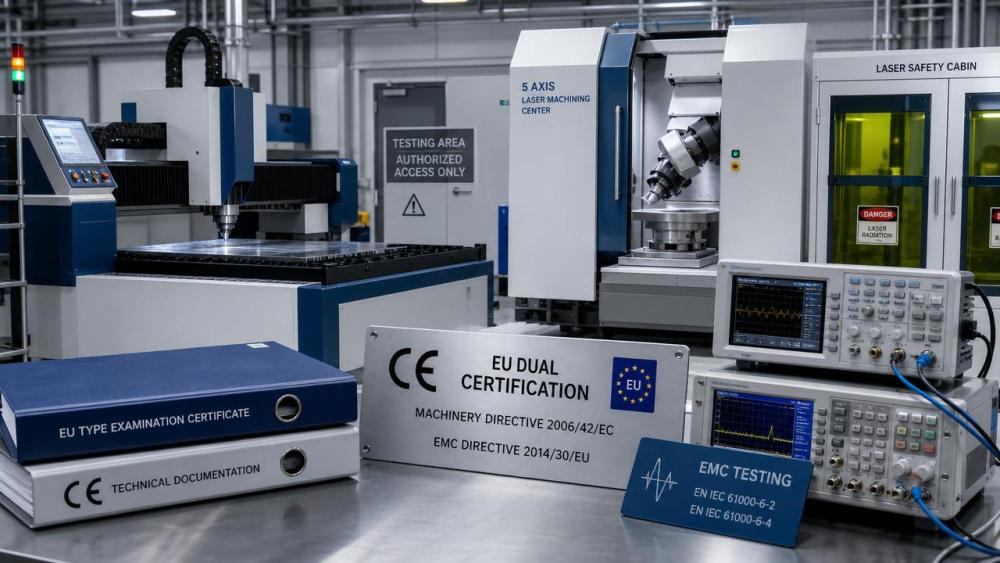
The confirmed change is that the revised version of the EU Electromagnetic Compatibility Directive (2014/30/EU) and the EN 60825-1:2024 standard will formally take effect on July 1, 2026.
According to the provided event summary, high-power fiber laser cutting machines, 3D 5-axis laser processing centers, and other covered equipment exported to the EU must obtain dual compliance: EMC immunity testing and Laser Class 4 safety certification.
The summary also states that products without both certifications will be refused customs clearance and barred from sale in the EU.
This requirement directly covers three target categories identified in the input: High-Power Fiber Laser, 3D 5-Axis Laser, and Ultrafast Lasers.
Where the rule change will be felt first
Export-facing manufacturers will face a stricter shipment gate
For equipment manufacturers and export businesses serving the EU market, the immediate impact is that product readiness is no longer defined only by technical delivery or customer acceptance. The ability to ship and sell now depends on whether the equipment can present both the EMC-related and laser safety-related compliance results required by the new rule.
From an operational perspective, what deserves closer attention is the pre-shipment stage: technical file preparation, certification status review, and alignment between product configuration and compliance documentation may become more sensitive parts of order execution.
Procurement and project teams may need earlier compliance checks
Buyers, sourcing teams, and project planners involved in EU-bound laser equipment purchases may also be affected because certification status can become a practical prerequisite for ordering, acceptance planning, and delivery scheduling.
Analysis shows that for the covered categories, procurement discussions may need to move beyond price, specifications, and lead time to include whether the supplier can support the required dual certification path and related technical documents.
Testing, certification, and document support will become more visible in delivery workflows
For companies involved in testing support, certification coordination, export documentation, and related supply-chain services, the rule change raises the importance of document completeness and consistency. The issue is not only whether a product is designed for performance, but whether the supporting compliance materials are available in a form that matches EU market-entry requirements.
Observably, this may affect how exporters organize testing schedules, prepare supporting files, and coordinate handover materials for customs clearance and sales access.
After-sales and traceability teams should watch the installed-base implications
For after-sales providers and quality traceability teams, the rule change matters because equipment access to the EU market is explicitly tied to certification status. Even where the input does not provide detailed enforcement procedures, companies handling installation support, warranty response, or model traceability should pay closer attention to how shipped units are documented and identified.
This is especially relevant for businesses managing multiple laser product categories under one export program, including High-Power Fiber Laser, 3D 5-Axis Laser, and Ultrafast Lasers.
Practical issues companies should now review
Check whether covered models already align with the dual requirement
The first practical question is whether EU-bound models in the affected categories have been reviewed against both EMC immunity testing and Laser Class 4 certification requirements. If that review has not been completed, companies may need to treat it as a front-end compliance screening item rather than a late-stage shipping formality.
Revisit technical files and tender-facing materials
Where bids, quotations, specification sheets, or delivery files are used for EU business, companies should look closely at whether their documents clearly match the new certification condition. Analysis shows that inconsistencies between product claims, testing status, and technical documentation can become a commercial risk even before shipment.
Build more time into procurement and delivery planning
Because the input confirms a hard effective date and a direct sales-access consequence for non-certified products, businesses should pay attention to how certification readiness may affect production release, order confirmation, and export timing. The input does not provide detailed implementation timelines beyond the effective date, so this remains an area that requires careful monitoring rather than assumption.
Watch for follow-up wording and execution signals
It is more appropriate to understand this development as a rule change with immediate compliance significance, while also recognizing that companies still need to watch for follow-up wording, execution practice, and market-facing document changes. In practical terms, that includes certification interpretation, customs-facing expectations, and changes in buyer documentation requirements.
Why this reads as more than a technical update
From an industry perspective, this development is not simply a revision of testing language. It links product compliance more directly to market access, which changes how exporters and buyers need to treat certification status in transaction planning.
Analysis shows that the most important signal at this stage is the shift from optional preparation to mandatory readiness for covered laser categories. At the same time, because the input does not provide detailed enforcement practice beyond the stated consequences, the market still needs to observe how certification expectations are reflected in actual procurement documents, customs review, and day-to-day execution.
How the market may best read this stage
The clearest takeaway is that this is a confirmed compliance threshold for certain laser equipment entering the EU from July 1, 2026. For affected businesses, the immediate relevance lies in certification planning, export document readiness, and delivery risk control rather than in broad market speculation.
At present, it is more appropriate to understand this as an implemented rule change with direct commercial consequences, while keeping a cautious watch on how the detailed execution language, certification practice, and buyer-side requirements continue to develop.
Basis of this article and what still needs verification
This article is generated based on the user-provided news title, event date, and event summary. The confirmed factual basis used here is limited to the stated effective date, the referenced EU directive and standard, the dual-certification requirement, the consequence for non-certified products, and the covered product categories.
For developments of this type, commonly relevant source categories may include official regulatory notices, information released by supervisory authorities, customs or trade administration updates, industry association notices, standards organization documents, and reporting by authoritative trade media.
No specific official source link was provided in the input, so the exact official source link remains to be verified. What still requires continued checking includes detailed implementation wording, certification interpretation, customs execution practice, tender document changes, market feedback, and how affected companies carry out compliance preparation in practice.
Product Recommendations
 Abrasive Delivery SystemsIndustrial Waterjet Cutters: Abrasive Costs That Erode MarginsAnalyst :5-Axis Machining Scientist
 All-Electric Press BrakesAll-Electric Servo Drives: Energy Savings vs Upgrade CostAnalyst :Precision Turning Architect
 All-Electric Press BrakesReal-Time Angle Compensation: What It Fixes and What It Doesn'tAnalyst :Precision Turning Architect
 Latest Sector NewsHigh-Strength Steel Machining: Tool Life Myths to AvoidAnalyst :Dr. Alistair Vaughn
 3D 5-Axis LaserComposite Material Cutting Without Delamination: Key MethodsAnalyst :
 Robotic Bending CellsAutomated Sheet Metal Forming: Hidden Setup Costs ComparedAnalyst :Precision Turning Architect