
Effective June 1, 2026, China Customs has rolled out a dedicated Smart Clearance Channel for high-end manufacturing equipment at major ports nationwide — significantly accelerating export processing for precision industrial systems and enhancing delivery predictability for global buyers.
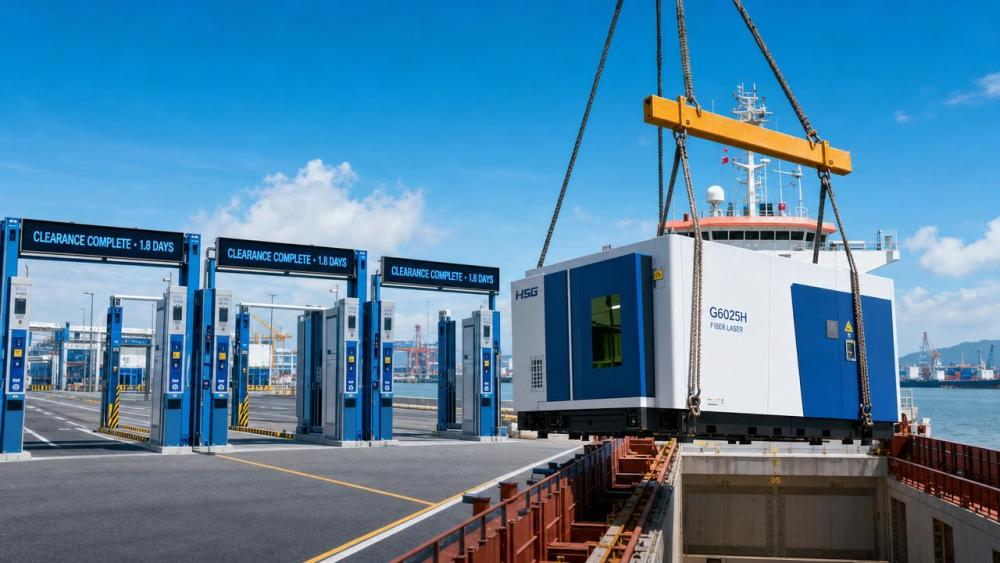
Smart Clearance Channel Goes Live Nationwide
Starting June 1, 2026, the General Administration of Customs of China activated the Smart Clearance Channel for Export of High-End Equipment across key national ports. The channel covers 17 categories of advanced manufacturing equipment, including 5-Axis Dynamic Waterjets, Ultra-high Pressure Pumps, and High-Power Fiber Laser systems. Average customs clearance time has been reduced to 1.8 working days — a 3.2-fold improvement over standard procedures. The initiative integrates AI-powered pre-clearance document review and intelligent origin verification to streamline processing.
Impact Across the Industrial Value Chain
Export-Oriented Manufacturing Enterprises
These enterprises benefit directly from shortened lead times, as faster customs release improves order fulfillment certainty for overseas clients. They must now ensure technical documentation, origin declarations, and conformity evidence align precisely with AI-driven validation logic — deviations may trigger manual review and delay.
Raw Material and Component Suppliers
Suppliers supporting high-end equipment production face tighter coordination requirements. Just-in-time delivery schedules for critical subsystems (e.g., laser sources or ultra-high-pressure manifolds) must now synchronize with accelerated export windows — increasing pressure on traceability and batch-level compliance documentation.
Contract Manufacturers and System Integrators
For firms assembling multi-vendor systems, the new channel intensifies scrutiny on bill-of-materials provenance and subcomponent origin labeling. Mixed-origin assemblies require granular origin mapping to pass automated origin verification — prompting updates to internal sourcing records and supplier declarations.
Logistics and Trade Compliance Service Providers
Freight forwarders and customs brokers must upgrade their digital interfaces to support real-time AI pre-audit feedback loops. Manual entry or paper-based certificate handling is no longer compatible with the channel’s operational rhythm — requiring integration with customs’ electronic declaration platforms and origin-data exchange protocols.
Key Operational Priorities for Enterprises
Validate Origin Documentation Against AI Verification Logic
Origin statements must follow standardized formats and include verifiable production step records — especially for complex assemblies. Self-declared origin without supporting process logs risks automatic rejection during intelligent origin核验 (origin verification).
Pre-Submit Technical Documentation for AI Pre-Audit
Equipment specifications, safety certifications (e.g., CE, CCC), and test reports should be submitted electronically prior to shipment. AI pre-review identifies inconsistencies early — reducing last-minute corrections and avoiding clearance bottlenecks.
Align Delivery Schedules with 1.8-Day Clearance Expectation
Procurement planning and customer commitments must reflect the new baseline clearance window. Overpromising delivery without accounting for upstream supply chain variability — even under fast-track clearance — could erode credibility with international buyers.
Maintain Real-Time Traceability for Critical Subcomponents
Traceability systems must capture origin, manufacturing date, and conformity status per batch for all covered equipment classes. This supports both AI origin verification and post-clearance audit readiness.
Industry Perspective: Beyond Speed — A Shift in Compliance Architecture
Analysis shows this initiative reflects a broader transition from procedural compliance to data-native regulatory engagement. It is more appropriate to understand the Smart Clearance Channel not merely as a time-saving measure, but as an infrastructure layer that rewards digital maturity, documentation discipline, and upstream supply chain transparency. Observably, manufacturers investing in integrated ERP–PLM–compliance data flows gain disproportionate advantage — while those relying on fragmented, siloed documentation face growing friction despite identical hardware eligibility.
Strategic Implication for Global Industrial Trade
This development signals a tightening alignment between China’s export control framework and global delivery expectations in capital-intensive industrial markets. It does not eliminate technical or regulatory barriers — but reshapes how compliance is verified, shifting emphasis from retrospective audits to real-time, evidence-based validation. For international buyers, it increases confidence in Chinese suppliers’ operational reliability — provided those suppliers proactively adapt their internal control systems.
Source Attribution and Monitoring Guidance
This article synthesizes the information provided in the user input: title, event date (2026-06-01), and event summary. Specific official source links were not provided in the input and should be verified continuously. Stakeholders are advised to monitor upcoming implementation guidelines from the General Administration of Customs of China, updates to the List of Eligible Equipment Categories, and evolving industry feedback on AI pre-audit false-positive rates and origin verification thresholds.
Product Recommendations
 Abrasive Delivery SystemsIndustrial Waterjet Cutters: Abrasive Costs That Erode MarginsAnalyst :5-Axis Machining Scientist
 All-Electric Press BrakesAll-Electric Servo Drives: Energy Savings vs Upgrade CostAnalyst :Precision Turning Architect
 All-Electric Press BrakesReal-Time Angle Compensation: What It Fixes and What It Doesn'tAnalyst :Precision Turning Architect
 Latest Sector NewsHigh-Strength Steel Machining: Tool Life Myths to AvoidAnalyst :Dr. Alistair Vaughn
 3D 5-Axis LaserComposite Material Cutting Without Delamination: Key MethodsAnalyst :
 Robotic Bending CellsAutomated Sheet Metal Forming: Hidden Setup Costs ComparedAnalyst :Precision Turning Architect