
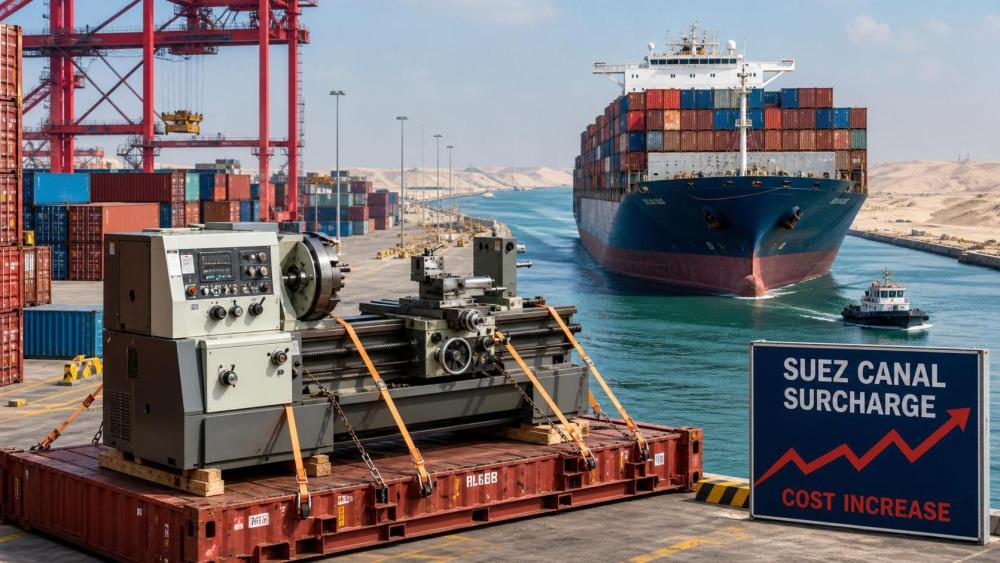
On June 20, 2026, the latest escalation in Red Sea-related shipping risk became a direct cost issue for Asia-Europe trade. After the Suez Canal Authority announced an added security charge for container vessels transiting the canal, freight costs on the route moved higher, with heavy-duty lathes and other overweight or oversized equipment facing a sharper impact. For machine tool importers, exporters, logistics providers, and project-based equipment buyers, the development matters not only because of higher ocean rates, but because insurance, delivery planning, and route selection are now moving together.
What Has Been Confirmed So Far
The Suez Canal Authority (SCA) announced on June 18, 2026 that, due to continuing security threats, an additional security fee would be imposed on all container ships passing through the canal starting June 20.
The immediate result described in the provided information is a broad increase in freight rates on Asia-Europe routes.
For a 40-foot high-cube container, the sea freight cost of transporting heavy-duty lathes and other overweight or oversized equipment has increased by US$1,200 per container. At the same time, insurance rates have risen by 25%, bringing the overall logistics cost increase to 22%.
The provided information also states that multiple European machine tool importers have already started evaluating alternative shipping routes.
Why the Impact Is Uneven Across the Chain
Machine tool traders are exposed to immediate landed-cost pressure
From an industry perspective, companies directly trading heavy-duty lathes are likely to feel the effect first because their quotations, delivery commitments, and import cost calculations are closely tied to ocean freight and insurance. What deserves closer attention is whether existing offers, especially for cargo already under negotiation, can still absorb the extra US$1,200 per container and the broader logistics increase without requiring repricing.
Manufacturers of oversized equipment face delivery and planning strain
For manufacturers shipping heavy or out-of-gauge equipment, the issue is not limited to freight expense. Analysis shows that any rise in route-related charges can affect shipment batching, container allocation, and delivery scheduling. Where projects depend on specific delivery windows, cost pressure can quickly turn into execution pressure.
European importers must weigh route flexibility against procurement timing
The fact that several European machine tool importers are assessing backup routes suggests that import-side planning is already shifting. Observably, buyers in Europe may need to compare the cost impact of staying on the Suez-linked route with the operational implications of changing routes, especially for equipment with tight installation or production schedules.
Logistics and insurance service providers need closer cargo-level coordination
For freight forwarders, carriers, and insurance-related service providers, the key issue is that surcharge changes and insurance adjustments now directly affect equipment categories with high shipment values and complex handling needs. In practice, communication around cargo specifications, declared value, and routing assumptions becomes more important when costs are moving at the same time.
What Companies Should Watch Next
Track official wording and any rule adjustments
Companies should pay close attention to whether the scope, duration, or application method of the added security fee changes in subsequent official statements. The current announcement establishes the charge from June 20, but practical execution details often determine how quickly the extra cost reaches individual shipments.
Review contracts and quotations for heavy equipment shipments
What deserves closer attention is the treatment of freight and insurance fluctuations in ongoing orders. For heavy-duty lathes and similar equipment, businesses should recheck whether current quotations, shipping terms, and customer commitments still reflect the actual logistics cost base after the surcharge and insurance increase.
Prepare route alternatives without assuming they are a full solution
The route review started by some European machine tool importers is a notable market response. Analysis shows that evaluating backup routes may help with contingency planning, but it should be separated from the assumption that every shipment can be switched easily. Companies need to compare route options against cargo type, timing, and delivery obligations.
Strengthen customer and supplier communication around lead times
For ongoing transactions, the practical priority is clear communication. Exporters, importers, and service providers should align on possible delivery changes, cost pass-through discussions, and documentation expectations so that higher logistics costs do not create avoidable disputes during execution.
How This Development Should Be Read
Analysis shows that this is more than a narrow freight adjustment for one route. The combination of a canal-related security surcharge, higher insurance costs, and early route reassessment by European machine tool importers indicates that Red Sea risk is continuing to shape commercial decisions in the equipment trade.
At the same time, it is more appropriate to understand this as an active industry development rather than a settled long-term pattern. The confirmed facts show a clear cost increase and an initial market response, but the extent of longer-term route shifts or procurement changes still requires continued observation.
What the Industry Signal Means Right Now
At this stage, the key significance of the news is that logistics risk has again become a direct pricing factor for heavy industrial equipment moving on Asia-Europe lanes. For companies involved in heavy-duty lathe trade, procurement, shipping, or delivery management, the issue is not simply whether rates have risen, but how quickly those higher transport and insurance costs are being transmitted into orders and timelines.
It is more appropriate to understand this development as a near-term cost and planning signal with potential wider implications, rather than as a final conclusion about future trade patterns. Continued monitoring remains necessary.
Basis of This Article
This article is based on the user-provided news title, event date, and event summary. The information referenced here is limited to the stated SCA announcement timing, the start date of the added security fee, the reported freight and insurance cost changes, and the note that multiple European machine tool importers have begun evaluating alternative routes.
For this type of industry development, commonly relevant source categories may include official notices, company statements, industry association updates, authoritative media coverage, and shipping-related documentation. A specific official source link was not provided in the input, so further verification remains necessary. Continued attention should focus on any follow-up SCA wording, implementation details of the surcharge, and whether route evaluation by importers develops into broader operational change.
Product Recommendations
 Abrasive Delivery SystemsIndustrial Waterjet Cutters: Abrasive Costs That Erode MarginsAnalyst :5-Axis Machining Scientist
 All-Electric Press BrakesAll-Electric Servo Drives: Energy Savings vs Upgrade CostAnalyst :Precision Turning Architect
 All-Electric Press BrakesReal-Time Angle Compensation: What It Fixes and What It Doesn'tAnalyst :Precision Turning Architect
 Latest Sector NewsHigh-Strength Steel Machining: Tool Life Myths to AvoidAnalyst :Dr. Alistair Vaughn
 3D 5-Axis LaserComposite Material Cutting Without Delamination: Key MethodsAnalyst :
 Robotic Bending CellsAutomated Sheet Metal Forming: Hidden Setup Costs ComparedAnalyst :Precision Turning Architect