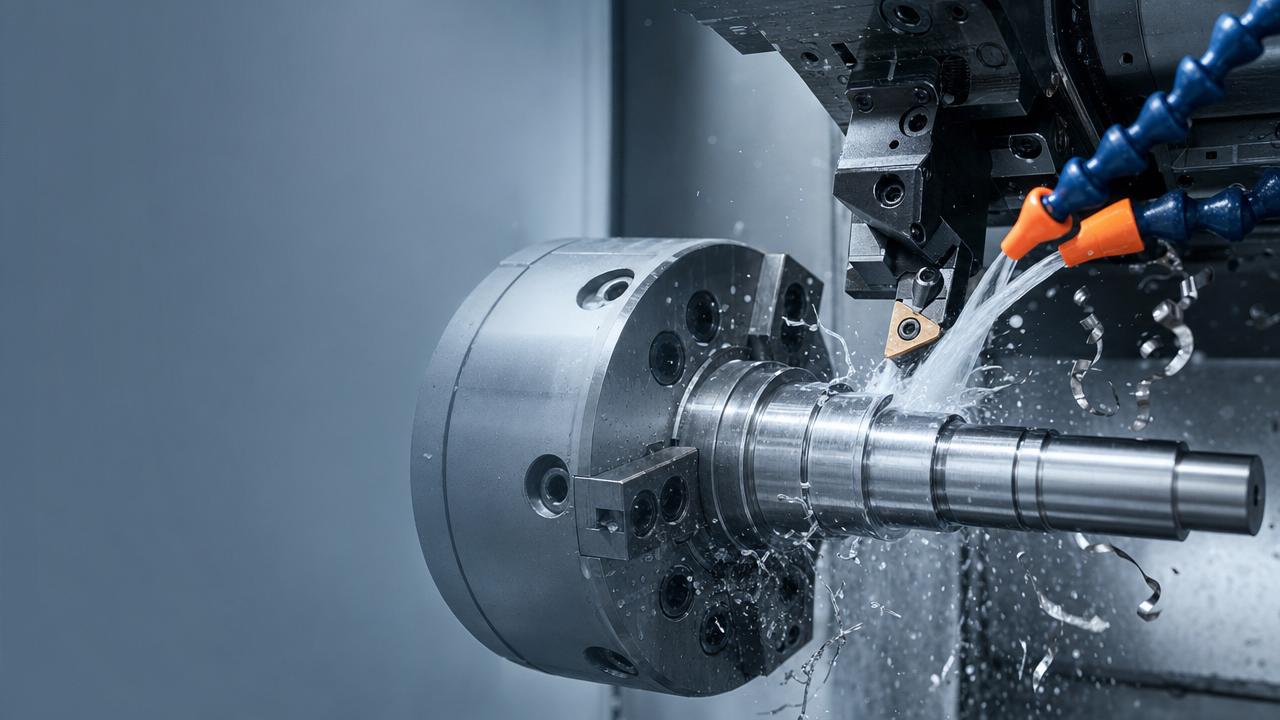
Marine drive shafts often appear simple in drawings: a long cylindrical component, a set of journals, shoulders, threads, tapers, and tight dimensional requirements. In production, however, marine drive shafts combine nearly every difficulty that can slow precision machining—large diameter-to-length ratios, variable material behavior, deflection during turning, distortion after heat treatment, and inspection complexity over long spans. As vessel propulsion systems evolve toward higher torque, better efficiency, and longer service intervals, the machining requirements behind marine drive shafts are becoming stricter, not easier. Delivery delays usually begin long before the final machining pass, and they often trace back to early planning decisions rather than shop-floor execution alone.
Why marine drive shafts are becoming a more critical delivery risk
Across advanced manufacturing, long rotating components are under renewed scrutiny because end-use expectations have changed. In marine propulsion, this means marine drive shafts must support higher transmitted loads, lower vibration, tighter concentricity, and more predictable lifecycle performance. At the same time, supply chains are less tolerant of rework, machine capacity is tighter, and any interruption in forging, heat treatment, straightening, or finish turning can compound into missed delivery windows.
This is why marine drive shafts are now a strategic machining topic rather than just a conventional turning job. The challenge is not only cutting metal. It is controlling geometry, residual stress, and process stability from rough stock to final inspection while preserving schedule reliability. In many cases, the delay is created by a mismatch between shaft design assumptions and the actual behavior of the part under machining forces.
The strongest trend signals point to tighter tolerances and less schedule flexibility
Several industry signals explain why machining marine drive shafts has become more sensitive to delay. First, vessel operators increasingly expect lower noise and better drivetrain efficiency, which pushes shaft alignment and runout control higher on the quality checklist. Second, heavy-duty alloy steels and corrosion-resistant grades are being specified more often, and these materials can behave unpredictably during long-cycle machining. Third, project schedules have less built-in buffer, so one straightness correction or one failed inspection report can affect assembly timing downstream.
From a manufacturing intelligence perspective, marine drive shafts sit at the intersection of turning technology, support strategy, thermal control, and metrology discipline. Shops with capable CNC lathes can still struggle if the process window is narrow or if intermediate checks are skipped. That is why the trend is moving toward more simulation-backed planning, more stable fixturing, and more inspection points across the routing.
Where delivery delays usually begin in marine drive shafts machining
The delays behind marine drive shafts are rarely random. They tend to start in a small number of recurring areas that are easy to underestimate during quoting or route creation.
In other words, marine drive shafts are vulnerable to cumulative error. A small bend after roughing may still allow the next operation to continue, but once finish stock becomes limited, the part can no longer absorb correction. That is when a routine order turns into a delivery problem.
The main technical forces driving these machining challenges
- High aspect ratio geometry increases susceptibility to bending, chatter, and tool-pressure-induced movement.
- Forged or large rolled stock may contain uneven internal stress, which is released asymmetrically during stock removal.
- Marine drive shafts often require multiple journals and functional diameters with tight relationships, so local corrections can create global alignment problems.
- Heavy roughing and long cycle times raise thermal sensitivity, affecting both the part and the machine structure.
- Support systems such as tailstocks, follow rests, and steady rests help, but incorrect pressure or placement can mark the part or introduce distortion.
- Inspection over long lengths is more difficult than on compact parts, especially when straightness, total indicated runout, and coaxiality must all be verified consistently.
These factors explain why machining marine drive shafts is a system-level challenge. Machine capability matters, but so do stock condition, process sequencing, support design, intermediate measurement, and stock allowance strategy.
How the impact spreads across production, quality, and downstream assembly
When marine drive shafts slip behind plan, the effect is broader than a single work order. Production schedules become unstable because long-part machining ties up high-value lathe capacity for extended periods. If rework is needed, machine availability for other jobs is reduced. Tool wear and support device adjustments also increase operator intervention, limiting predictable throughput.
Quality teams face a different burden. Marine drive shafts often require repeated checks of diameter, straightness, runout, shoulder position, and surface integrity. If the inspection plan is too back-loaded, nonconformities are discovered late, when correction is expensive. Downstream assembly then absorbs the consequences through fit-up problems, alignment concerns, or delayed balancing and installation. In practical terms, one unstable shaft can influence machining, inspection, logistics, and final commissioning all at once.
What deserves the closest attention before machining marine drive shafts
- Incoming stock condition: Verify straightness, hardness consistency, ultrasonic integrity, and realistic machining allowance.
- Stress management: Plan roughing symmetry and consider stress-relief stages before critical finishing.
- Datum continuity: Keep center holes, journals, and reference surfaces aligned with a clear setup transfer strategy.
- Support engineering: Define tailstock load, steady-rest placement, and follow-rest conditions according to shaft geometry, not habit.
- Thermal control: Monitor coolant stability, cycle duration, and measurement timing to avoid false readings.
- Intermediate inspection: Insert checkpoints after roughing, heat treatment, semi-finishing, and pre-final pass.
- Final stock reserve: Avoid leaving too little material for geometric correction after process variation appears.
For marine drive shafts, these checkpoints are not administrative overhead. They are the main controls that keep the route realistic and prevent late-stage surprises.
A more reliable response is shifting from reactive correction to planned process control
The most effective response to marine drive shafts delivery risk is to build correction capability into the route instead of relying on emergency recovery. This starts with process segmentation: roughing, stabilization, semi-finishing, verification, and final finishing should each have a defined purpose. Roughing should remove material in a balanced way. Stabilization should allow stress to relax before precision dimensions are targeted. Semi-finishing should confirm whether the shaft remains within the correction window. Final finishing should happen only when geometry is already under control.
This aligns with a wider advanced manufacturing trend: smarter machining does not always mean more complex equipment, but better synchronization between process design, machine dynamics, and inspection logic. For marine drive shafts, that synchronization is often the difference between predictable delivery and recurring delay.
What the next judgment should focus on
The next step is not simply to ask whether a shop can machine marine drive shafts. The better question is whether the full process can absorb distortion, maintain references, and reveal problems early enough to protect schedule. This means evaluating capability in terms of long-part turning experience, support method design, stress-relief strategy, and long-length metrology discipline—not just spindle size or maximum turning diameter.
A practical review should compare planned tolerances against material condition, setup count, in-process checkpoints, and available correction windows. If any one of these is missing, the risk of delay rises sharply. Marine drive shafts reward disciplined planning because they expose every weak link in the machining chain.
For organizations tracking advanced manufacturing trends, marine drive shafts are a clear reminder that delivery performance is increasingly shaped by process intelligence. Better outcomes come from integrating turning expertise, thermal awareness, staged verification, and realistic route design from the start. When these controls are established early, marine drive shafts move from being a chronic schedule threat to a manageable high-precision job with far fewer surprises.
Product Recommendations
 Abrasive Delivery SystemsIndustrial Waterjet Cutters: Abrasive Costs That Erode MarginsAnalyst :5-Axis Machining Scientist
 All-Electric Press BrakesAll-Electric Servo Drives: Energy Savings vs Upgrade CostAnalyst :Precision Turning Architect
 All-Electric Press BrakesReal-Time Angle Compensation: What It Fixes and What It Doesn'tAnalyst :Precision Turning Architect
 Latest Sector NewsHigh-Strength Steel Machining: Tool Life Myths to AvoidAnalyst :Dr. Alistair Vaughn
 3D 5-Axis LaserComposite Material Cutting Without Delamination: Key MethodsAnalyst :
 Robotic Bending CellsAutomated Sheet Metal Forming: Hidden Setup Costs ComparedAnalyst :Precision Turning Architect